Cyber safety for Indian students
Someone your age already fell for it.
We break down the scams going after students in India — how each one works, what gives it away, and exactly what to do if one has already got you. No jargon, no lectures.
- Free to read
- No sign-up
- Plain English
Scammed in the last 24 hours? Call 1930 now.
The sooner a transfer is reported, the better the chance it can be frozen. Do that first, read later.
The six to know
Scams hitting students right now
Each one has its own page: a reconstruction of the real message, the red flags marked, and what to do if it already happened.
Fake job & internship offers
You’re “selected” for a role you never applied to — then asked for a registration fee.
UPI collect request fraud
A “refund” that isn’t. Approving it sends your money out, not in.
“Digital arrest” calls
Fake police on a video call telling you not to hang up and not to tell your parents.
OTP & KYC phishing
“Your account will be blocked today.” A lookalike link, then a call asking for your OTP.
Sextortion & video-call blackmail
A stranger, a quick video call, then a threat to send it to your contacts.
Fake scholarship & result sites
A lookalike government portal asking for your Aadhaar, bank details and a small fee.
The pattern
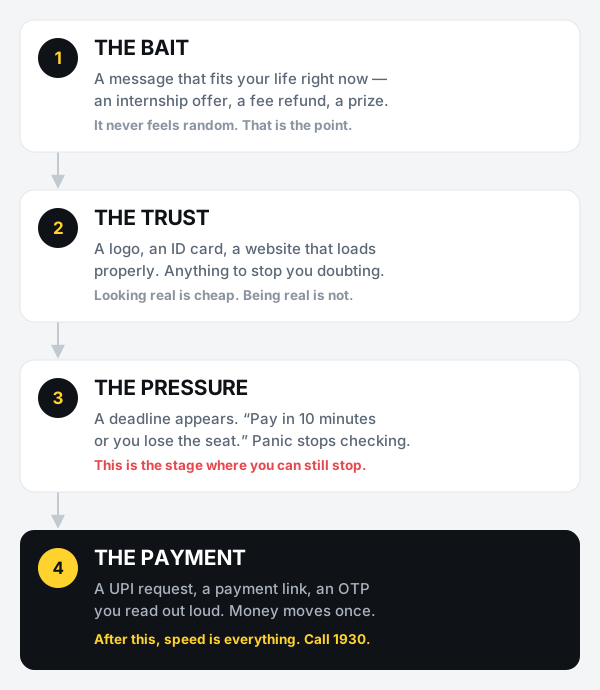
Every scam runs the same four steps
The story changes — a job, a refund, a police case, a scholarship. The machinery underneath does not. Once you can see the four stages, you start spotting them a step earlier every time.
Most people think they got caught because they weren’t clever enough. That’s not what happened. They got caught because someone engineered a moment where thinking felt like a luxury.
Learn to notice stage three. The pressure is the tell, and it is the last point where nothing has been lost yet.
Three habits
Most scams die if you do one of these
You don’t need to be technical. You need three reflexes.
01
Slow it down
Anything urgent is suspicious by default. Nothing real collapses because you took ten minutes. Put the phone down and come back to it.
02
Go the other way round
Never use the link or number they sent. Search for the bank, college or company yourself and contact them through their own channel.
03
Say it out loud
Tell one person before you pay anything. Scams need privacy. Describing it to a friend usually ends it in one sentence.
If it already happened
Your first 24 hours
Do these in order. Skip the part where you feel stupid about it — that helps nobody and costs you time.
01
Stop the money
Call your bank’s official number and report the transaction. Ask them to freeze the beneficiary account.
02
Call 1930
The national cyber crime helpline. Free, and the fastest route to getting a transfer flagged.
03
Save everything
Screenshot the messages, the number, the UPI ID, the transaction reference. Don’t delete the chat.
04
File the complaint
Report it at cybercrime.gov.in and keep the acknowledgement number safe.
1930
The national cyber crime helpline. Free to call, and the number to use first.
cybercrime.gov.in
The official National Cyber Crime Reporting Portal. Every complaint should be filed here.
₹0
What it costs to read anything on this site, forever. No account, no paywall.
Why we exist
Awareness that respects you
Most cyber safety material for students is either a government PDF nobody opens or a fear campaign that treats you like you’re careless. Neither works.
We do one thing: explain exactly how a scam works, show you the real thing, and tell you what to do next. If you got caught, you’ll find no lecture here — just the steps, in order.

“The people who get scammed are not the careless ones. They’re the ones who were busy, hopeful, or in a hurry — which is everybody, eventually.”
The Digital Big Brother
Know a scam we haven’t covered?
If something reached you and you can’t find it here, send it over. Reader reports are how we decide what to write next.